
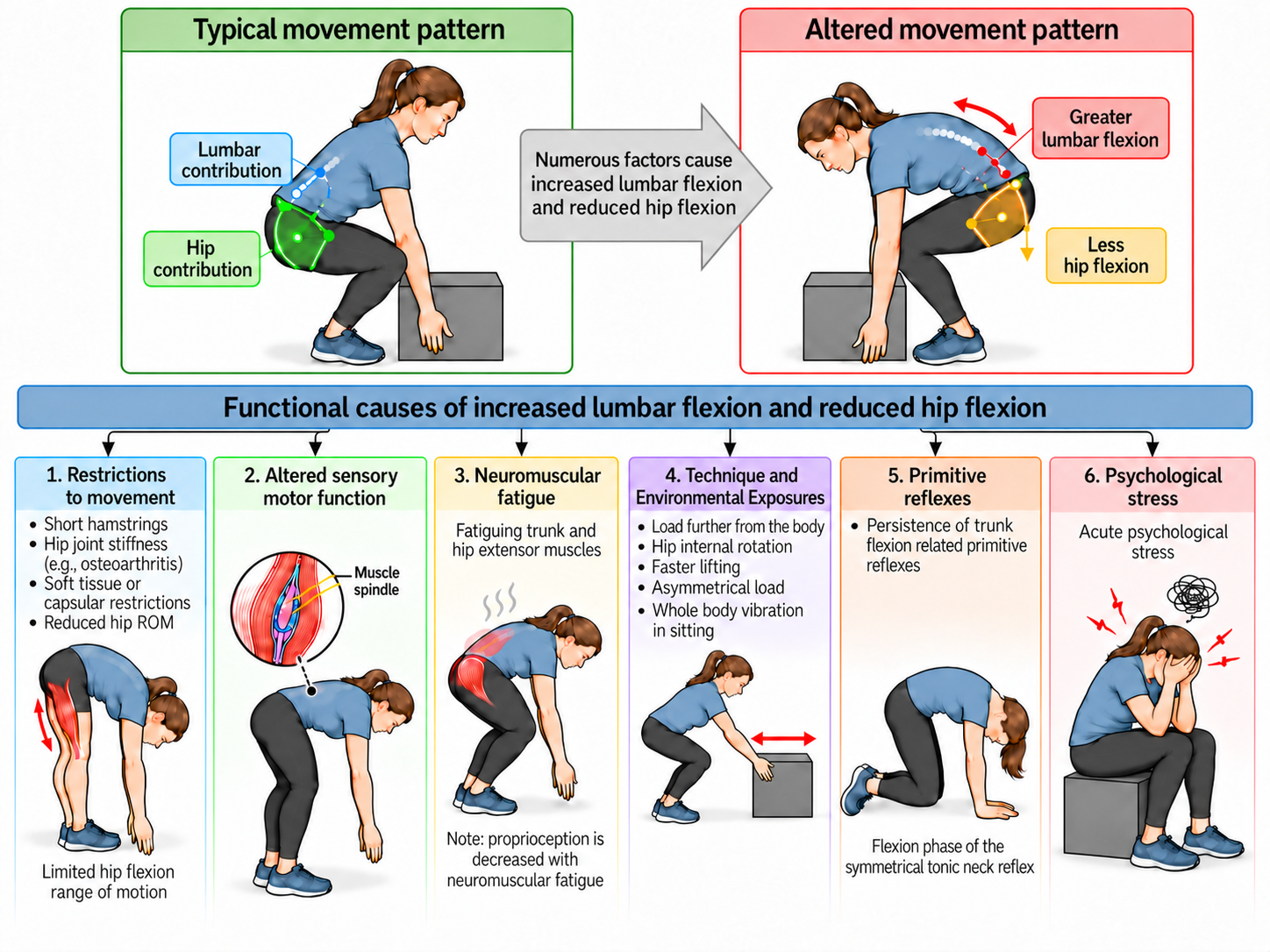
Controlling movement patterns are common in rehabilitation and are evidence based (whether you agree or not).
One of the limitations of this type of rehabilitation is that causation is rarely addressed (at least in the research).
This requires a “deeper” level of clinical reasoning and likely some metacognition.
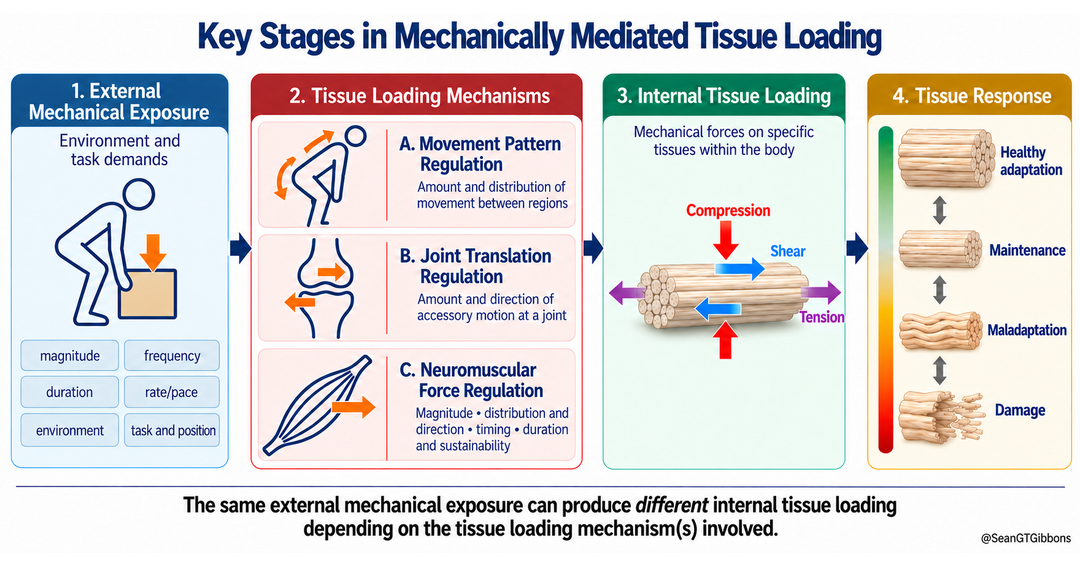
It can be challenging enough for novice clinicians to understand tissue loading mechanisms (e.g., movement pattern regulation). But in reality, there is a need to understand causation.
The first steps in clinical reasoning are to match the mechanism(s) to the possible source of nociception and to the patient’s symptoms. This is a strong starting point to start rehabilitation. Understanding the causation of the mechanism(s) is not always possible the first day is and is not required to start rehabilitation.
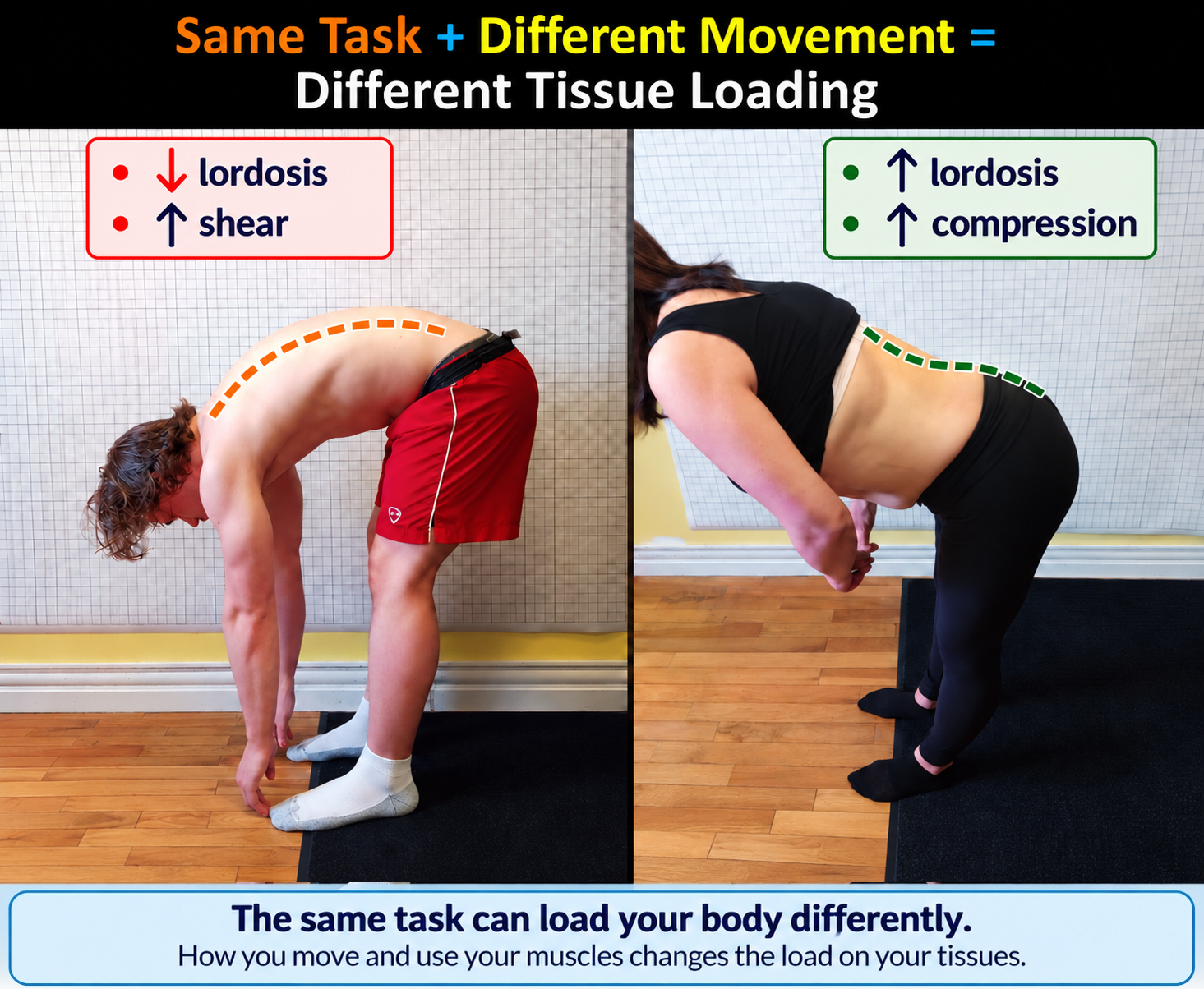
If your hypothesis is that someone has low back pain (patient’s symptom) due to a L4/5 disc (source of nociception) and the main tissue loading mechanism is habitual use of end range lumbar flexion during repeated lifting.
If the load can be modified, that can be one part of the intervention.
You can teach the patient to start controlling lumbar flexion with increased hip flexion, but what if the hip range of motion is limited?
What is the limitation? Hamstring (what is the cause of the reduced hamstring length?); neurodynamic reactivity (why is this present?); hip joint restriction (why is this present?)
Changing the load on the spine through bending the knees could be another part of the intervention. But what if the causation of habitual end range lumbar flexion is also a retained primitive reflex? As soon as the head goes into flexion, the spine goes into flexion so bending the knees does not have the desired effect of modifying the load. Why are the primitive reflexes present?
Would you like to learn more? Get in touch.
This post is based on the below project. Note: I incorrectly used the term “mechanisms” instead of “causes”.
Gibbons SGT 2017 What are the functional mechanisms of altered movement patterns
during trunk flexion tasks? The need for further sub-classification: A systematic review.
Musculoskeletal Science and Practice. 28: e16-17.
DOI:https://doi.org/10.1016/j.math.2016.10.043
https://www.mskscienceandpractice.com/article/S1356-689X(16)30791-3/abstract



Leave A Comment